Science & history · Asterism guide
The Teapot
The Teapot is eight bright stars of Sagittarius that look remarkably like a teapot, spout toward the scorpion, with the brightest part of the Milky Way rising beside it.
About this picture
NASA/Goddard Space Flight Center Scientific Visualization Studio. Gaia DR2: ESA/Gaia/DPAC. Constellation figures based on those developed for the IAU by Alan MacRobert of Sky and Telescope magazine (Roger Sinnott and Rick Fienberg). NASA's page (opens in a new tab).
The map is a composite of 1.7 billion catalogued stars, not a photograph from one place: it shows stars far too faint for the eye, and no weather, Moon or city light. It is drawn here in this chart's projection, with each star where it was in 2000; the fastest-moving bright star has shifted about a minute of arc since, far less than a pixel here.
How to spot it: Eight stars in the shape of a teapot, east of Scorpius's tail. Source (opens in a new tab)
Eight stars, one teapot
A handle, a lid, a body and a spout, all inside Sagittarius.
Ridpath (opens in a new tab) lists the eight stars: the handle is phi, sigma, tau and zeta Sagittarii, the top of the lid is lambda, and delta, epsilon and gamma make the triangular spout.
It lies within the constellation Sagittarius (opens in a new tab), so it is an asterism, not a constellation: a shape people see inside one of the IAU's areas. The Sagittarius guide covers the rest of the archer.
Sources for this section Ian Ridpath, Star Tales: Sagittarius (opens in a new tab); Preston Dyches, What Are Asterisms?, NASA Science (2021, updated 2024) (opens in a new tab)
How to find it
Find the scorpion's curved tail, then look east for the Teapot.
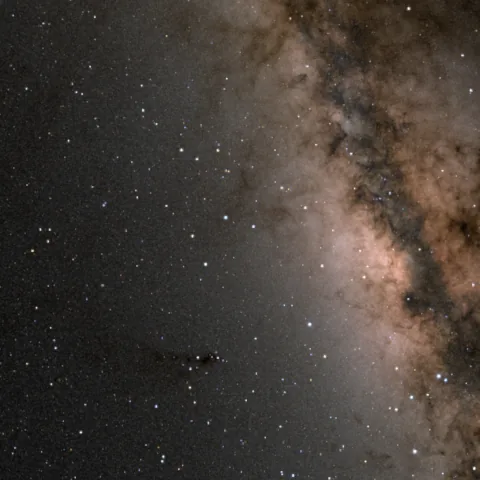
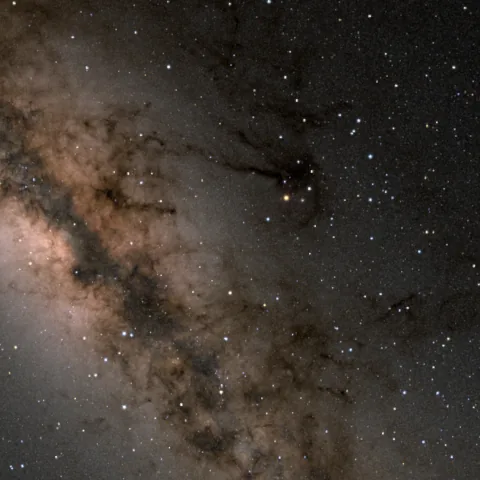
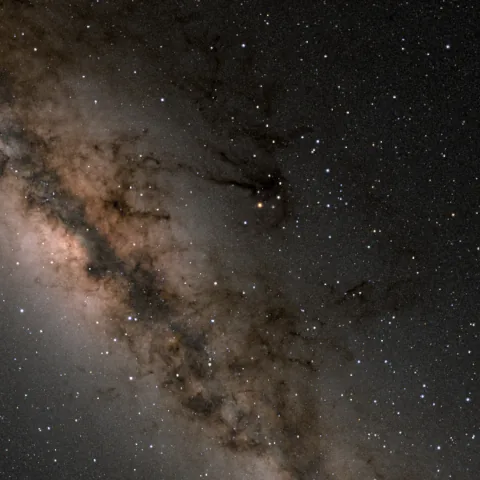
The archer is drawn aiming at Scorpius (opens in a new tab), and in NASA's photograph (opens in a new tab) the Teapot sits just to the left of the scorpion: find red Antares and the curl of the tail, then look east.
By this site's calculation (opens in a new tab), the Teapot's middle reaches only about 21° up in the south from 40°N but about 84° up in the north from 35°S, and it is highest at about 9 p.m. local time in mid-August.
Keep in mind NASA notes (opens in a new tab) that it is best seen under skies without a lot of light pollution, and from mid-northern latitudes it never climbs far above the southern horizon, where haze and city glow are worst.
Sources for this section Ian Ridpath, Star Tales: Sagittarius (opens in a new tab); Preston Dyches, What Are Asterisms?, NASA Science (2021, updated 2024) (opens in a new tab); Bright Star Catalogue, 5th Revised Ed. (Hoffleit & Warren 1991), as computed by this site's star engine (opens in a new tab)
Beside the centre of the Galaxy
Just past the spout lies the direction of the centre of our Galaxy.
Sagittarius holds dense Milky Way star fields (opens in a new tab) toward the centre of our Galaxy, whose exact centre, the radio source Sagittarius A*, lies close to the point of the archer's arrow. Gamma Sagittarii, at the spout's tip, takes its name, Alnasl, from the Arabic for “the point”.
Under dark skies the Milky Way is at its richest here: the Night Sky Network (opens in a new tab) notes that for Northern Hemisphere observers its most prominent part rises in the south-east with Scorpius and Sagittarius.
Sources for this section Ian Ridpath, Star Tales: Sagittarius (opens in a new tab); Kat Troche (Astronomical Society of the Pacific), The Great Rift, NASA Night Sky Network (2025) (opens in a new tab)
Before it was a teapot
The same stars were a bow, a dipper, and two Chinese lunar mansions.
The Teapot is a modern name. Ridpath (opens in a new tab) notes that its stars, with mu, were originally seen as the archer's bow and arrow, and that Aratus even wrote of the Archer and the Bow as if they were separate constellations.
Five of them make the Milk Dipper (opens in a new tab), and Chinese astronomers saw a dipper here too: Dou, the Southern Dipper, one of the 28 lunar mansions, beside Ji, the winnowing basket. A Chinese proverb has the southern dipper mark life and the northern one death. The Book of Poetry (opens in a new tab) calls them the Ladle and the Sieve.
Sources for this section Ian Ridpath, Star Tales: Sagittarius (opens in a new tab); The Shih King (Book of Poetry), Minor Odes, Fifth Decade, Ode 9 (Ta Tung), tr. James Legge (Sacred Books of the East vol. 3, 1879), Project Gutenberg #9394 (opens in a new tab)
Where on Earth, and when
The whole key pattern rises from anywhere south of about 56°N.
North of about 65°N, none of it rises.
South of about 65°S, the whole key pattern never sets.
Its middle climbs at least 20° high, the finder's threshold for a suggestion, from anywhere south of about 41°N.
It is highest in the evening sky, at about 9 p.m. local time, in mid-August, from either hemisphere, wherever it rises. With daylight saving time, that is nearer 10 p.m. on the clock.
Worked out by this site from the Bright Star Catalogue, for a flat, clear horizon. Hills, buildings, haze and city light all cut into this; the air also lifts objects near the horizon by about half a degree. For your own place and night, use the sky finder.
Sources
- History Ian Ridpath, Star Tales: Sagittarius (opens in a new tab) for the Teapot's stars, the Milk Dipper, the bow, the Galaxy's centre and the Chinese mansions · checked 2 October 2026
- Astronomy Preston Dyches, What Are Asterisms?, NASA Science (2021, updated 2024) (opens in a new tab) for the Teapot within Sagittarius and light pollution · checked 27 September 2026
- Astronomy Kat Troche (Astronomical Society of the Pacific), The Great Rift, NASA Night Sky Network (2025) (opens in a new tab) for the Milky Way beside it · checked 27 September 2026
- History The Shih King (Book of Poetry), Minor Odes, Fifth Decade, Ode 9 (Ta Tung), tr. James Legge (Sacred Books of the East vol. 3, 1879), Project Gutenberg #9394 (opens in a new tab) for the Ladle and the Sieve · checked 2 October 2026
- Astronomy Bright Star Catalogue, 5th Revised Ed. (Hoffleit & Warren 1991), as computed by this site's star engine (opens in a new tab) for its height from 40°N and 35°S, and best month