Science & history · Sky basics
The zodiac, the constellations and Ophiuchus
The Sun's yearly path crosses 13 constellations, including Ophiuchus. Astrology's twelve signs are something else: equal 30° divisions of that path, counted from the spring equinox.
The Sun's path through the constellations
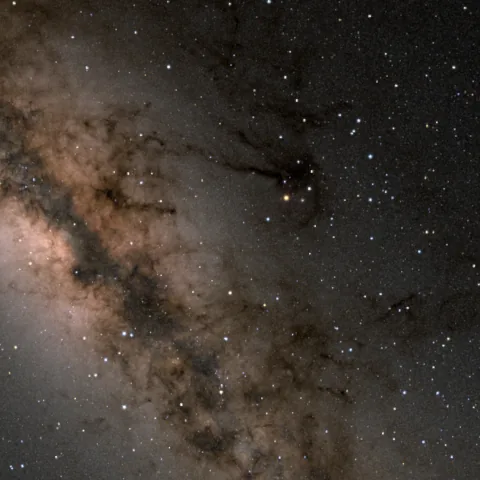
Over a year the Sun appears to pass in front of 13 constellations of different sizes.
In astronomy, the IAU explains (opens in a new tab), the constellations of the zodiac are those along the Sun's apparent path against the stars. They are not evenly spaced: each has its own shape and size inside its official borders, so the Sun spends different lengths of time in each.
By that definition Ophiuchus is one of them (opens in a new tab), and has been for some time. NASA (opens in a new tab) puts it simply: the Sun actually moves through 13 constellations, not 12.
You cannot watch the Sun among the stars, but you can see the result: the constellations behind the Sun are hidden in daylight, as in NASA Space Place's example (opens in a new tab) of Virgo in September.
Sources for this section International Astronomical Union, Astronomy FAQs (opens in a new tab); NASA, Constellations and the Calendar (2016) (opens in a new tab); NASA Space Place, What Are Constellations? (updated 2022) (opens in a new tab)
Twelve equal signs
Astrology's signs are twelve equal slices of the circle, a symbolic system, not a map of constellations.
NASA describes the ancient zodiac as 12 equal parts (opens in a new tab), like a pizza cut into 12 equal slices. In the Western tradition each sign is 30° of the circle.
Where the circle starts is a convention. Ptolemy wrote in the second century that the zodiac has no natural beginning (opens in a new tab), being a circle, and that the sign beginning at the spring equinox, Aries, is taken as the starting point of them all. Signs counted that way are fixed to the seasons, not to the stars.
Because Earth's axis slowly shifts (opens in a new tab), the sky has moved since the zodiac was laid out, and the signs and the constellations of the same names no longer line up.
Sources for this section NASA, Constellations and the Calendar (2016) (opens in a new tab); Ptolemy, Tetrabiblos I.10, tr. F. E. Robbins (Loeb, 1940), LacusCurtius (opens in a new tab)
Nobody changed your sign
Astronomy did not add a thirteenth sign; the signs and the constellations are different systems.
When stories spread in 2016 that NASA had changed the zodiac, NASA replied (opens in a new tab) that it had not changed any signs; it had only done the maths of the Sun's path.
Ophiuchus is an astronomical constellation that the Sun crosses. It is not an automatic thirteenth sign in the traditional twelve-sign system, which counts its signs from the equinox rather than from constellation borders. NASA Space Place (opens in a new tab) draws the wider line: astronomy follows evidence and data, while astrology's claims are not based on scientific evidence.
Keep in mind The signs and what they are said to mean are covered, on their own terms and labelled as symbolism, in Astrology & myths.
Sources for this section NASA, Constellations and the Calendar (2016) (opens in a new tab); NASA Space Place, What Are Constellations? (updated 2022) (opens in a new tab)
Sources
- Astronomy International Astronomical Union, Astronomy FAQs (opens in a new tab) for the zodiac in astronomy and Ophiuchus · checked 27 September 2026
- Astronomy NASA, Constellations and the Calendar (2016) (opens in a new tab) for 13 constellations, 12 equal parts, the shifting axis and no changed signs · checked 2 October 2026
- Astronomy NASA Space Place, What Are Constellations? (updated 2022) (opens in a new tab) for constellations hidden by the Sun, and astronomy versus astrology · checked 27 September 2026
- Practitioner Ptolemy, Tetrabiblos I.10, tr. F. E. Robbins (Loeb, 1940), LacusCurtius (opens in a new tab) for where the zodiac begins · checked 27 September 2026