Science & history · Star basics
Colour and temperature
Stars are not all white. A star's colour tells you the temperature of its surface: blue-white stars are the hottest, orange and red ones the coolest.
Colour means temperature
Hotter stars look blue or white; cooler stars look orange or red.
Stars vary in colour because they vary in temperature (opens in a new tab): hotter stars appear blue or white, cooler stars orange or red. Astronomers sort main-sequence stars into classes by colour and temperature: O (blue), B (blue-white), A (white), F (yellow-white), G (yellow), K (orange) and M (red).
Real stars fit the pattern. Rigel (opens in a new tab) is a class B star with a surface near 11,500 kelvin, and looks blue-white; Sirius (opens in a new tab), about 10,500 kelvin, looks white; red giants such as Arcturus (opens in a new tab) look more orange than red.
Sources for this section NASA Science, Stars in an Exoplanet World (opens in a new tab); Jim Kaler, Rigel, STARS (University of Illinois) (opens in a new tab); NASA Science, Astronomers Use Hubble to 'Weigh' Dog Star's Companion (2005) (opens in a new tab); NASA Science, Star Types (opens in a new tab)
Colour is not size, and not brightness
A red star can be tiny or enormous; a white one can be dazzling or nearly invisible.
Colour, size and brightness are separate things. Red dwarfs (opens in a new tab) are the smallest and coolest stars, too faint to see without a telescope, yet Betelgeuse (opens in a new tab), also red, is so large it would reach past Jupiter's orbit if it sat where the Sun is.
Likewise white dwarfs (opens in a new tab) are hot and can glow blue-white, but they are Earth-sized and far too dim to see with the unaided eye, while Sirius A (opens in a new tab), white and only about twice the Sun's mass, is the brightest star in the night sky.
How bright a star looks depends on how much light it gives out and how close it is, NASA explains (opens in a new tab); brightness and distance covers that.
Sources for this section NASA Science, Star Types (opens in a new tab); NASA Science, Hubble Finds that Betelgeuse's Mysterious Dimming Is Due to a Traumatic Outburst (2020) (opens in a new tab); NASA Science, Astronomers Use Hubble to 'Weigh' Dog Star's Companion (2005) (opens in a new tab); NASA Science, Stars in an Exoplanet World (opens in a new tab)
Where to see the difference
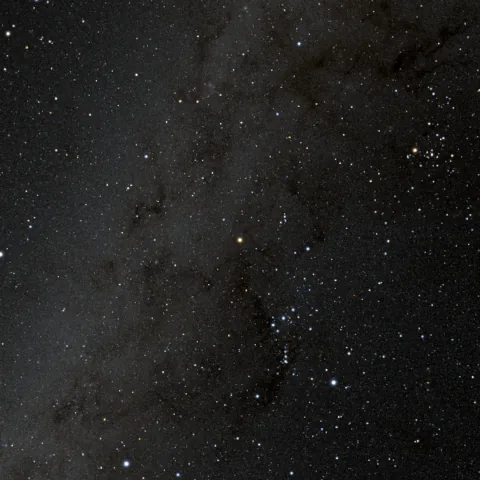
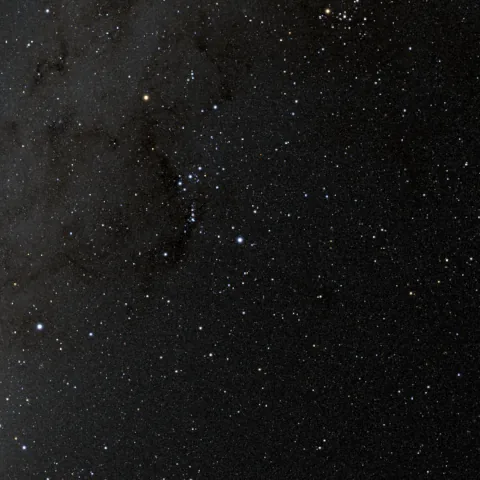
Orion shows the contrast best: red Betelgeuse at one corner, blue-white Rigel at the other.
In Orion, red Betelgeuse and blue-white Rigel sit at opposite corners, and the colours are noticeable from Earth (opens in a new tab) because Rigel's surface is thousands of degrees hotter.
Jim Kaler (opens in a new tab) offers a northern trio of almost equal brightness: Arcturus orange, Vega white, Capella yellow-white between them. Through a small telescope, Albireo (opens in a new tab) in Cygnus shows two stars of contrasting colours side by side.
Keep in mind A bright star near the horizon can flash red, green and blue. That is the air (opens in a new tab) bending different colours by different amounts, not the star's own colour; why stars twinkle.
Sources for this section NASA Science, Discovering the Universe Through the Constellation Orion (opens in a new tab); Jim Kaler, Capella, STARS (University of Illinois) (opens in a new tab); Ian Ridpath, Star Tales: Cygnus (opens in a new tab); Robert Nemiroff and Jerry Bonnell, Scintillating, Astronomy Picture of the Day, NASA (28 April 2011) (opens in a new tab)
Sources
- Astronomy NASA Science, Stars in an Exoplanet World (opens in a new tab) for colour and temperature classes, and brightness · checked 27 September 2026
- Astronomy Jim Kaler, Rigel, STARS (University of Illinois) (opens in a new tab) for Rigel's class and temperature · checked 27 September 2026
- Astronomy NASA Science, Astronomers Use Hubble to 'Weigh' Dog Star's Companion (2005) (opens in a new tab) for Sirius's temperature and mass · checked 27 September 2026
- Astronomy NASA Science, Star Types (opens in a new tab) for red giants, red dwarfs and white dwarfs · checked 27 September 2026
- Astronomy NASA Science, Hubble Finds that Betelgeuse's Mysterious Dimming Is Due to a Traumatic Outburst (2020) (opens in a new tab) for Betelgeuse's size · checked 27 September 2026
- Astronomy NASA Science, Discovering the Universe Through the Constellation Orion (opens in a new tab) for Betelgeuse and Rigel's colours · checked 27 September 2026
- Astronomy Jim Kaler, Capella, STARS (University of Illinois) (opens in a new tab) for Arcturus, Vega and Capella · checked 27 September 2026
- History Ian Ridpath, Star Tales: Cygnus (opens in a new tab) for Albireo · checked 27 September 2026
- Astronomy Robert Nemiroff and Jerry Bonnell, Scintillating, Astronomy Picture of the Day, NASA (28 April 2011) (opens in a new tab) for colour flicker near the horizon · checked 27 September 2026