Science & history · Star basics
How stars are born, live and die
Stars are born in cold clouds of gas and dust. How much mass a star starts with decides almost everything after that: how long it lives, how brightly it shines and how it ends.
Born in cold clouds
Stars form where cold clouds of gas and dust collapse under their own gravity.
Stars form in molecular clouds (opens in a new tab), cold clouds of gas and dust from 1,000 to 10 million times the Sun's mass. The cold lets the gas clump; some clumps gather more matter until gravity makes them collapse, heating up into a protostar, a star in the making.
Stars tend to be born in batches. NASA (opens in a new tab) calls groups of newly formed stars stellar clusters, and clouds full of them stellar nurseries. Collapsing clouds often break up (opens in a new tab) into two or three blobs, which would explain why most stars in the Milky Way come in pairs or multiples.
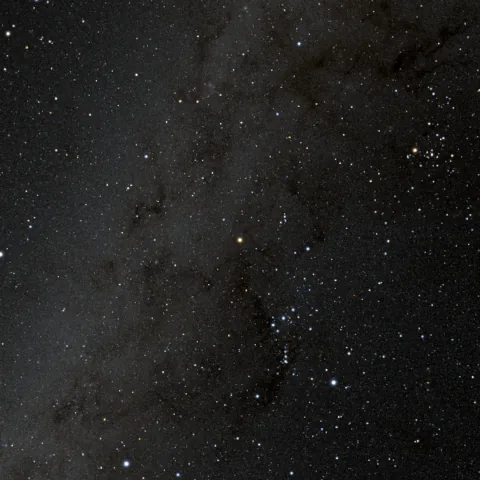
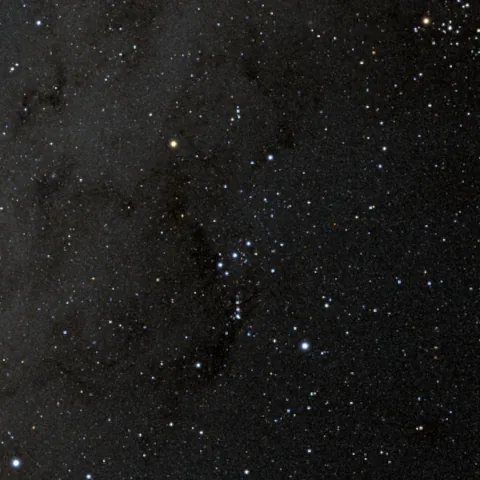
How to see it The nearest big nursery you can see is the Orion Nebula (opens in a new tab), the fuzzy middle “star” of Orion's sword, visible to the naked eye under moderately dark skies. How to find it.
Sources for this section NASA Science, Star Basics (opens in a new tab); NASA Science, Stars in an Exoplanet World (opens in a new tab); Kat Troche (Astronomical Society of the Pacific), A Flame in the Sky – the Orion Nebula, NASA Night Sky Network (2023) (opens in a new tab)
Mass decides the lifetime
Small stars live for trillions of years; the most massive for only a few million.
A star's mass determines how fast it uses its fuel (opens in a new tab). Lower-mass stars burn longer, dimmer and cooler; massive stars must use fuel faster to hold themselves up. Some low-mass stars will shine for trillions of years, longer than the universe has existed, while some massive stars live only a few million.
Red dwarfs (opens in a new tab), the smallest main-sequence stars, may last up to about 14 trillion years and make up around 75 percent of the Milky Way's stars, yet none is bright enough to see with the unaided eye.
The bright stars you can see include some of the shortest-lived. NASA estimates (opens in a new tab) Betelgeuse at about 10 million years old and Rigel at about 8 million, against nearly 5 billion for the Sun.
Sources for this section NASA Science, Star Basics (opens in a new tab); NASA Science, Star Types (opens in a new tab); NASA Science, Discovering the Universe Through the Constellation Orion (opens in a new tab)
How stars end
Most stars end as white dwarfs; only the most massive explode as supernovae.
When a star like the Sun runs out of hydrogen in its core, it swells into a giant (opens in a new tab), eventually blows off its outer layers as an expanding cloud called a planetary nebula, and leaves its core behind as a white dwarf, a roughly Earth-sized cinder that cools over billions of years. That will be the Sun's fate.
Only stars of more than about eight times the Sun's mass (opens in a new tab) die in a supernova, when the core, having fused all the way to iron, collapses and rebounds. What remains (opens in a new tab) is a neutron star or a black hole, and the material thrown out enriches the clouds that make the next generation of stars.
So not every star becomes a supernova. NASA's star types page (opens in a new tab) has stars of less than about eight times the Sun's mass swelling into red giants and ending as white dwarfs, and a white dwarf in a close pair (opens in a new tab) can flare up as a nova, which is not a supernova.
How to see it You can see all three stages: the nursery in Orion, a giant in Arcturus, the shell of a dying star in the Ring Nebula, a white dwarf beside Sirius, and the wrecks of supernovae in Taurus and Cassiopeia. NASA's star types page (opens in a new tab) names Arcturus as a red giant you can see with the unaided eye.
Sources for this section NASA Science, Star Basics (opens in a new tab); NASA Science, Stars in an Exoplanet World (opens in a new tab); NASA Science, Star Types (opens in a new tab)
Sources
- Astronomy NASA Science, Star Basics (opens in a new tab) for star birth, lifetimes and endings · checked 27 September 2026
- Astronomy NASA Science, Stars in an Exoplanet World (opens in a new tab) for multiple stars, the supernova mass limit and novae · checked 27 September 2026
- Astronomy NASA Science, Star Types (opens in a new tab) for red dwarfs and red giants · checked 27 September 2026
- Astronomy Kat Troche (Astronomical Society of the Pacific), A Flame in the Sky – the Orion Nebula, NASA Night Sky Network (2023) (opens in a new tab) for the Orion Nebula · checked 27 September 2026
- Astronomy NASA Science, Discovering the Universe Through the Constellation Orion (opens in a new tab) for the ages of Betelgeuse and Rigel · checked 27 September 2026