Science & history · Constellation guide
Aquila, the eagle
Aquila, the eagle, is marked by Altair, a bright star with a fainter star close on each side. Altair spins so fast that it bulges at its equator.
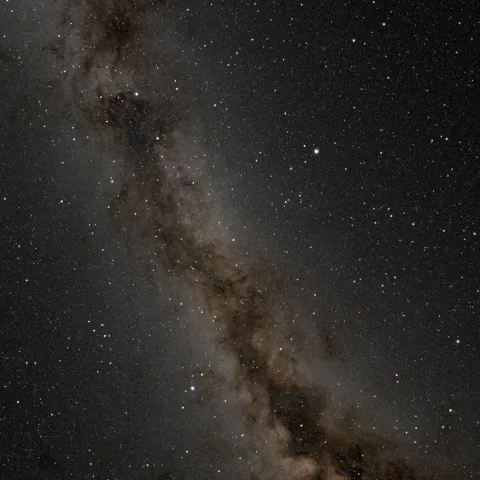
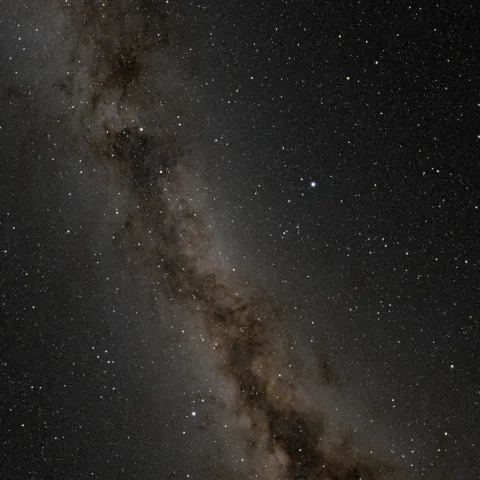
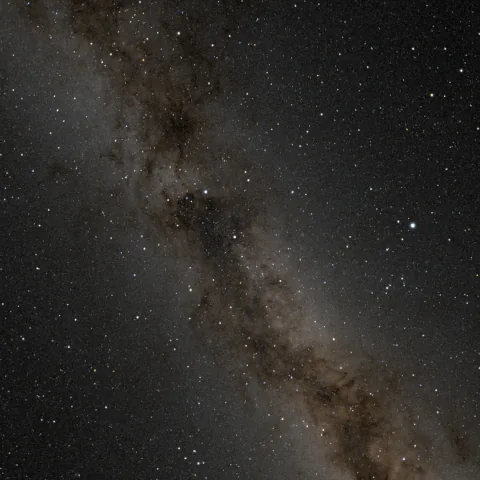
About this picture
NASA/Goddard Space Flight Center Scientific Visualization Studio. Gaia DR2: ESA/Gaia/DPAC. Constellation figures based on those developed for the IAU by Alan MacRobert of Sky and Telescope magazine (Roger Sinnott and Rick Fienberg). NASA's page (opens in a new tab).
The map is a composite of 1.7 billion catalogued stars, not a photograph from one place: it shows stars far too faint for the eye, and no weather, Moon or city light. It is drawn here in this chart's projection, with each star where it was in 2000; the fastest-moving bright star has shifted about a minute of arc since, far less than a pixel here.
How to spot it: Bright Altair with a fainter star close on either side, the Summer Triangle's southern corner. Source (opens in a new tab)
What you are looking at
An eagle seen from below, with Altair at the base of its neck.
Aquila's Greek name, Aetos, means eagle (opens in a new tab): the bird of Zeus that carried his thunderbolts. It is the 22nd largest constellation, and Ridpath notes that Ptolemy's description has the eagle seen from below, as it is on Flamsteed's atlas.
Its brightest star is Altair (opens in a new tab), from the Arabic al-nasr al-ṭā'ir, “the flying eagle” (or vulture): Arab astronomers saw Altair and the two stars beside it as a bird with wings outstretched. Those two, beta and gamma, are Alshain and Tarazed, from a Persian phrase for “the balance”, for the way the three make a weighing beam.
Sources for this section Ian Ridpath, Star Tales: Aquila (opens in a new tab)
Altair, the squashed star
Altair spins so fast that it bulges at its equator and is darker there than at its poles.
The NASA Night Sky Network (opens in a new tab) describes Altair as spinning so rapidly that it looks “squished”. Its rapid spin was first detected in the 1960s, and interferometry, which combines the light of several telescopes, later produced direct images of its shape.
Models predicted a pumpkin-like shape and a dimmer equator, and the observations confirmed both (opens in a new tab). The effect, gravity darkening, makes the denser poles hotter and brighter than the bulging equator; the equator is not dark, only darker by comparison.
Altair is close: 16.8 light-years (opens in a new tab) in ESA's list, at magnitude 0.76.
Sources for this section Kat Troche (Astronomical Society of the Pacific), Summer Triangle Corner: Altair, NASA Night Sky Network (opens in a new tab); ESA, Hipparcos: The 50 Brightest Stars (opens in a new tab)
How to find it
Altair is the Summer Triangle's southern corner, and the last of the three to rise for northern observers.
The Summer Triangle (opens in a new tab) is Vega in Lyra, Deneb in Cygnus and Altair in Aquila. For Northern Hemisphere observers Altair is the last of the three to rise before summer, and it is high overhead at sunset by the end of the season in September.
By this site's calculation (opens in a new tab), Aquila's middle stands about 59° up in the south at its highest from 40°N and about 46° up in the north from 35°S: it lies near the celestial equator and can be seen from almost everywhere. It is highest at about 9 p.m. local time in mid-August.
How to see it Look for a bright star with a fainter one close on each side, Tarazed and Alshain (opens in a new tab): no other corner of the Triangle has that little line of three.
Sources for this section Kat Troche (Astronomical Society of the Pacific), Summer Triangle Corner: Altair, NASA Night Sky Network (opens in a new tab); Bright Star Catalogue, 5th Revised Ed. (Hoffleit & Warren 1991), as computed by this site's star engine (opens in a new tab); Ian Ridpath, Star Tales: Aquila (opens in a new tab)
A figure coming apart
In 1992 one of the eagle's stars drifted across the border into the next constellation.
Ridpath (opens in a new tab) records that rho Aquilae, on the leading edge of the eagle's northern wing, was carried across the boundary into neighbouring Delphinus by its own motion in 1992, an early sign of how today's figures will slowly disperse.
ESA explains (opens in a new tab) why this happens: every star has its own proper motion across the sky, too slow to notice in a lifetime but enough, over millennia, to change the constellations. The boundaries, fixed by the IAU, stay put.
Sources for this section Ian Ridpath, Star Tales: Aquila (opens in a new tab); ESA, How does Gaia study the Milky Way? (opens in a new tab)
Where on Earth, and when
The whole key pattern rises from anywhere north of about 76°S.
South of about 87°S, none of it rises.
North of about 87°N, the whole key pattern never sets.
Its middle climbs at least 20° high, the finder's threshold for a suggestion, from latitudes between 61°S and 79°N.
It is highest in the evening sky, at about 9 p.m. local time, in mid-August, from either hemisphere, wherever it rises. With daylight saving time, that is nearer 10 p.m. on the clock.
Worked out by this site from the Bright Star Catalogue, for a flat, clear horizon. Hills, buildings, haze and city light all cut into this; the air also lifts objects near the horizon by about half a degree. For your own place and night, use the sky finder.
Sources
- History Ian Ridpath, Star Tales: Aquila (opens in a new tab) for the figure, its star names and rho Aquilae · checked 2 October 2026
- Astronomy Kat Troche (Astronomical Society of the Pacific), Summer Triangle Corner: Altair, NASA Night Sky Network (opens in a new tab) for Altair's spin and shape, and the Summer Triangle · checked 27 September 2026
- Astronomy ESA, Hipparcos: The 50 Brightest Stars (opens in a new tab) for Altair's distance and magnitude · checked 27 September 2026
- Astronomy ESA, How does Gaia study the Milky Way? (opens in a new tab) for proper motion · checked 27 September 2026
- Astronomy Bright Star Catalogue, 5th Revised Ed. (Hoffleit & Warren 1991), as computed by this site's star engine (opens in a new tab) for its height from 40°N and 35°S, and best month