Science & history · Sky basics
Clusters and chance patterns
Most star patterns are chance alignments. A few groups are the real thing: clusters of stars born together and still travelling together.
Most patterns are chance
A constellation's stars are usually unrelated, at very different distances.
The IAU (opens in a new tab) notes that the stars making up the original constellation patterns have, in most cases, no physical connection with each other; they simply happen to line up as seen from Earth.
The Summer Triangle is a clear case: Altair is 16.8 light-years (opens in a new tab) away and Vega 25.3, while Deneb is about 1,400 (opens in a new tab). It is a shape, not a group.
Sources for this section International Astronomical Union, The Constellations (opens in a new tab); ESA, Hipparcos: The 50 Brightest Stars (opens in a new tab); Ian Ridpath, Star Tales: Cygnus (opens in a new tab)
Clusters are families
Star clusters are groups of stars born together and held together by gravity.
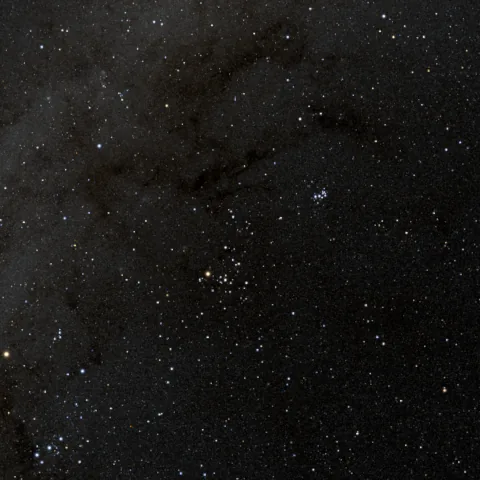
Stars form in batches, and NASA calls (opens in a new tab) groups of recently formed stars stellar clusters. The Pleiades (opens in a new tab) are an open cluster of more than a thousand stars loosely bound by gravity, of which a handful of bright ones stand out.
The Hyades (opens in a new tab), the V of Taurus, are an older open cluster, hundreds of millions of years old and spread out, the nearest cluster to us. Globular clusters such as Messier 22 (opens in a new tab) are something else again: dense balls of very old stars, typically 12 to 13 billion years old.
Sources for this section NASA Science, Star Basics (opens in a new tab); NASA Hubble, Messier 45 (the Pleiades) (opens in a new tab); Kat Troche (Astronomical Society of the Pacific), Spot the Young Stars of the Hyades and Pleiades, NASA Night Sky Network (2023) (opens in a new tab); NASA Hubble, Messier 22 (opens in a new tab)
Telling them apart
A tight, rich knot of stars is often a cluster; a big, open shape almost never is.
Even inside a real cluster, one star can be an impostor. Bright orange Aldebaran (opens in a new tab) stands out in the Hyades V but is not a member: it lies between us and the cluster.
Clusters also give themselves away by age and family likeness. The Night Sky Network (opens in a new tab) sets the Pleiades, the Hyades and the Orion Nebula side by side as stars at different stages of life, from newborn to mature.
How to see it Look at the Pleiades with binoculars and then at the Summer Triangle: one is a crowd of stars at one distance, the other three stars at three. Binoculars (opens in a new tab) bring out many more Pleiades stars.
Sources for this section Kat Troche (Astronomical Society of the Pacific), Spot the Young Stars of the Hyades and Pleiades, NASA Night Sky Network (2023) (opens in a new tab)
Sources
- Astronomy International Astronomical Union, The Constellations (opens in a new tab) for patterns without physical connection · checked 27 September 2026
- Astronomy ESA, Hipparcos: The 50 Brightest Stars (opens in a new tab) for the distances of Altair and Vega · checked 27 September 2026
- History Ian Ridpath, Star Tales: Cygnus (opens in a new tab) for Deneb's distance · checked 27 September 2026
- Astronomy NASA Science, Star Basics (opens in a new tab) for stellar clusters · checked 27 September 2026
- Astronomy NASA Hubble, Messier 45 (the Pleiades) (opens in a new tab) for the Pleiades · checked 27 September 2026
- Astronomy Kat Troche (Astronomical Society of the Pacific), Spot the Young Stars of the Hyades and Pleiades, NASA Night Sky Network (2023) (opens in a new tab) for the Hyades, Aldebaran and the three ages · checked 27 September 2026
- Astronomy NASA Hubble, Messier 22 (opens in a new tab) for globular clusters · checked 2 October 2026