Science & history · Sky basics
Constellations, figures and asterisms
To astronomers a constellation is an area of sky with a boundary. The figure drawn between its stars is a tradition, and a pattern people use that is not a constellation is an asterism.
88 areas covering the sky
Since 1922 the IAU has recognised 88 constellations, and since 1928 they have had official borders.
By the 19th century, the IAU explains (opens in a new tab), more than a hundred constellations could be found on star charts, because astronomers kept inventing new ones, often to flatter a patron or monarch. At its first General Assembly, in Rome in 1922, the newly formed IAU agreed a list of 88 covering the whole sky, with three-letter abbreviations.
Boundaries came next. Eugène Delporte (opens in a new tab) proposed borders along lines of right ascension and declination, the sky's equivalents of longitude and latitude, keeping every known variable star in the constellation it already belonged to, which produced some awkward outlines. They were approved in 1928 and published in 1930.
Since then, when astronomers say something is “in” a constellation, they mean (opens in a new tab) it lies inside those borders, not that it is part of the star pattern.
Sources for this section International Astronomical Union, The Constellations (opens in a new tab)
The figures are traditions
The IAU defines no stick figures, and other cultures draw the same sky very differently.
For the IAU constellations no stick figures are formally defined (opens in a new tab), so the same constellation can be drawn in several ways. This site's charts are its own drawing, following common Western practice.
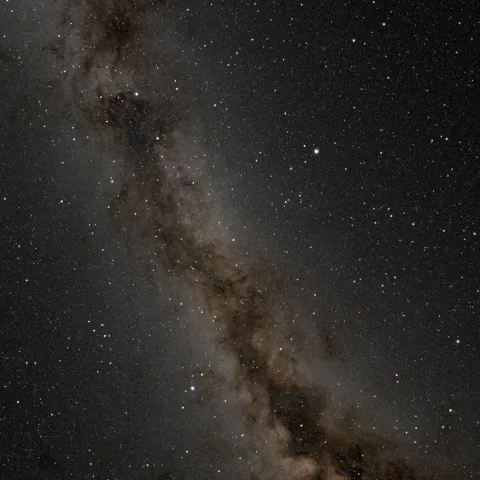
Other sky cultures group stars in their own ways. The IAU's page (opens in a new tab) describes Chinese constellations of only one to three stars, gathered into four great seasonal regions, and Inca constellations made of the dark clouds of the Milky Way rather than of stars.
Sources for this section International Astronomical Union, The Constellations (opens in a new tab)
Asterisms
An asterism is a familiar pattern that is not one of the 88: inside one constellation, or across several.
NASA's definition (opens in a new tab): besides the patterns within the 88 constellations, there are other familiar patterns of stars, called asterisms. The Big Dipper is part of Ursa Major; the Summer Triangle takes one bright star from each of three constellations.
The IAU adds (opens in a new tab) that an asterism can be made of a star cluster, like the Seven Sisters, of a pair of clusters, like the Pleiades and Hyades, or even of a single bright star.
How to see it Find the Big Dipper, then trace the fainter stars (opens in a new tab) of the rest of the Great Bear around it: the asterism is only part of the constellation.
Sources for this section Preston Dyches, What Are Asterisms?, NASA Science (2021, updated 2024) (opens in a new tab); International Astronomical Union, The Constellations (opens in a new tab); Ian Ridpath, Star Tales: Ursa Major (opens in a new tab)
Sources
- Astronomy International Astronomical Union, The Constellations (opens in a new tab) for the 88 constellations, their boundaries, figures, other sky cultures and asterisms · checked 27 September 2026
- Astronomy Preston Dyches, What Are Asterisms?, NASA Science (2021, updated 2024) (opens in a new tab) for what asterisms are · checked 27 September 2026