Astrology & myths · Tropical Western zodiac · Symbolic tradition
Scorpio, the Scorpion, in Western astrology
In the tropical Western zodiac, Scorpio is the eighth 30° of the circle counted from the March equinox. What follows is what that tradition says about it, and where each claim comes from.
The sign
Scorpio covers 210° to 240° of the tropical zodiac, a fixed slice of the circle, not a patch of stars.
Western astrology's signs are twelve equal divisions of the Sun's yearly path. Ptolemy explained in the second century that a circle has no natural beginning (opens in a new tab), so astrologers start at the spring equinox, and he describes the signs as intervals of 30° (opens in a new tab) from the equinoxes and solstices. Scorpio is the slice from 210° to 240°.
Its figure is old. The British Museum's Babylonian tablet (opens in a new tab) of about 500 BC pairs the corresponding month with “Scorpion”, and the medieval Islamic artists described by the Metropolitan Museum (opens in a new tab) drew the signs from Greek images.
Sources for this section Ptolemy, Tetrabiblos I.10, tr. F. E. Robbins (Loeb, 1940), LacusCurtius (opens in a new tab); Ptolemy, Tetrabiblos I.11, Of Solstitial, Equinoctial, Solid, and Bicorporeal Signs, tr. F. E. Robbins (Loeb, 1940), LacusCurtius (opens in a new tab); British Museum, tablet 77824 (1885,0430.15): months and signs of the zodiac (opens in a new tab); Marika Sardar, Astronomy and Astrology in the Medieval Islamic World, Heilbrunn Timeline of Art History, The Metropolitan Museum of Art (2011) (opens in a new tab)
Element, mode and ruler
In the modern Western teaching Scorpio is a water sign of the fixed mode; Ptolemy gave it to Mars.
The modern grouping of the twelve signs by element and mode is a standard part of astrological teaching: the Faculty of Astrological Studies (opens in a new tab) teaches the signs by polarity, element and mode, and Encyclopaedia Britannica (opens in a new tab) lists Scorpio as water, fixed.
Ptolemy's own terms are older and different. He calls Scorpio a solid sign, one of the four that follow the solstitial and equinoctial signs (opens in a new tab), which modern astrologers call fixed; he counts it feminine (opens in a new tab); and he groups it in a triangle (opens in a new tab) with Cancer and Pisces, governed by Mars, with the Moon by night and Venus by day as co-rulers. The name “water” for that triangle belongs to the later teaching, not to Ptolemy.
Its traditional ruler comes from Ptolemy's account of the planets' houses (opens in a new tab), where Scorpio is given to Mars. This page uses only those traditional rulers; it adds no later planets to them.
Sources for this section Faculty of Astrological Studies, Foundation Course (course outline) (opens in a new tab); Encyclopaedia Britannica, Zodiac (opens in a new tab); Ptolemy, Tetrabiblos I.11, Of Solstitial, Equinoctial, Solid, and Bicorporeal Signs, tr. F. E. Robbins (Loeb, 1940), LacusCurtius (opens in a new tab); Ptolemy, Tetrabiblos I.12, Of Masculine and Feminine Signs, tr. F. E. Robbins (Loeb, 1940), LacusCurtius (opens in a new tab); Ptolemy, Tetrabiblos I.18, Of the Triangles, tr. F. E. Robbins (Loeb, 1940), LacusCurtius (opens in a new tab); Ptolemy, Tetrabiblos I.17, Of the Houses of the Several Planets, tr. F. E. Robbins (Loeb, 1940), LacusCurtius (opens in a new tab)
A reading angle
One way to think about the sign's symbolism, in this site's own words.
Reading angle (this site's editorial wording, not a historical quotation or a prediction): Endurance and attention to what is hidden, without the automatic “vengeful Scorpio” caricature.
That is a reflection on a symbol, not a description of anyone born under it. NASA notes that astrology's claims are not based on scientific evidence (opens in a new tab), and Britannica (opens in a new tab) that no correlation has been found between birth dates and personality.
Sources for this section NASA Space Place, What Are Constellations? (updated 2022) (opens in a new tab); Encyclopaedia Britannica, Zodiac (opens in a new tab)
Not the same as the constellation
The sign and the constellation Scorpius share a name and a history, but not a position.
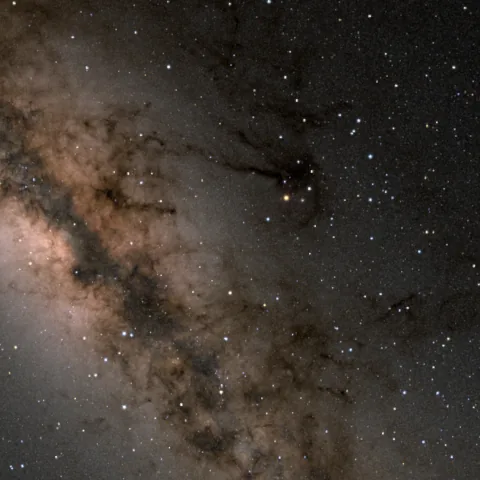
the constellation Scorpius is an area of sky with official borders, the 33rd largest (opens in a new tab) of the 88, and its Greek figure is the scorpion that killed Orion. The IAU (opens in a new tab) defines it by its boundary, not by any sign.
Because Earth's axis has shifted (opens in a new tab) since the zodiac was laid out, the Sun is no longer in the constellation on the dates assigned to the sign, and the constellations are of unequal size, so a sign's dates are never the dates the Sun spends in the constellation. The zodiac and Ophiuchus explains how the two systems differ.
Sources for this section Ian Ridpath, Star Tales: Scorpius (opens in a new tab); International Astronomical Union, The Constellations (opens in a new tab); NASA, Constellations and the Calendar (2016) (opens in a new tab)
Sources
Practitioner sources tell you what those practitioners say. They are not evidence that the stars do it.
- Practitioner Ptolemy, Tetrabiblos I.10, tr. F. E. Robbins (Loeb, 1940), LacusCurtius (opens in a new tab) for where the zodiac begins · checked 27 September 2026
- Practitioner Ptolemy, Tetrabiblos I.11, Of Solstitial, Equinoctial, Solid, and Bicorporeal Signs, tr. F. E. Robbins (Loeb, 1940), LacusCurtius (opens in a new tab) for the 30° signs and their four kinds · checked 2 October 2026
- Practitioner Ptolemy, Tetrabiblos I.12, Of Masculine and Feminine Signs, tr. F. E. Robbins (Loeb, 1940), LacusCurtius (opens in a new tab) for masculine and feminine signs · checked 2 October 2026
- Practitioner Ptolemy, Tetrabiblos I.17, Of the Houses of the Several Planets, tr. F. E. Robbins (Loeb, 1940), LacusCurtius (opens in a new tab) for the planets' houses, the traditional rulers · checked 2 October 2026
- Practitioner Ptolemy, Tetrabiblos I.18, Of the Triangles, tr. F. E. Robbins (Loeb, 1940), LacusCurtius (opens in a new tab) for the triangles and their governors · checked 2 October 2026
- Practitioner Faculty of Astrological Studies, Foundation Course (course outline) (opens in a new tab) for the modern grouping by polarity, element and mode · checked 2 October 2026
- Reference Encyclopaedia Britannica, Zodiac (opens in a new tab) for the element and mode of each sign, and the evidence · checked 2 October 2026
- History British Museum, tablet 77824 (1885,0430.15): months and signs of the zodiac (opens in a new tab) for the Babylonian figure · checked 2 October 2026
- History Marika Sardar, Astronomy and Astrology in the Medieval Islamic World, Heilbrunn Timeline of Art History, The Metropolitan Museum of Art (2011) (opens in a new tab) for the signs' Greek images · checked 2 October 2026
- Astronomy NASA Space Place, What Are Constellations? (updated 2022) (opens in a new tab) for astrology and evidence · checked 27 September 2026
- History Ian Ridpath, Star Tales: Scorpius (opens in a new tab) for the constellation's size and figure · checked 27 September 2026
- Astronomy International Astronomical Union, The Constellations (opens in a new tab) for constellations as areas · checked 27 September 2026
- Astronomy NASA, Constellations and the Calendar (2016) (opens in a new tab) for signs and constellations drifting apart · checked 2 October 2026