Science & history · Star basics
Distance, parallax and moving stars
The stars of a constellation look like a flat picture, but they lie at very different distances, and each is moving on its own. Over thousands of years, the pictures change.
A picture with depth
Stars that look side by side can be hundreds of light-years apart.
NASA Space Place (opens in a new tab) explains that the stars of a constellation are not connected to each other: some may be close to us and others very far away, joined only by the lines we draw.
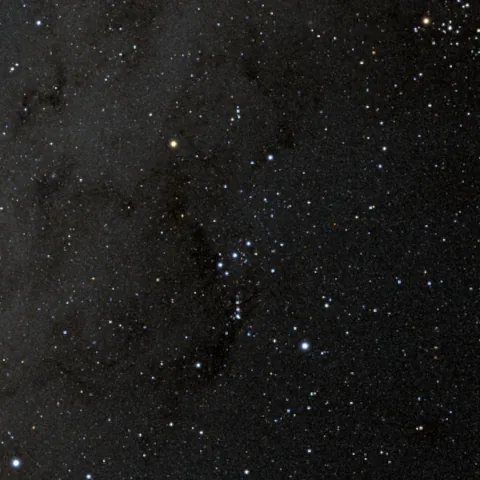
Orion's belt is the classic case. NASA gives (opens in a new tab) about 800 light-years for Alnitak, about 1,300 for Alnilam and about 900 for Mintaka, three stars that look like a matched set from Earth.
The IAU (opens in a new tab) sums it up: in most cases the stars of a constellation pattern have no physical connection, and all constellations are a matter of perspective.
Sources for this section NASA Space Place, What Are Constellations? (updated 2022) (opens in a new tab); NASA Science, Discovering the Universe Through the Constellation Orion (opens in a new tab); International Astronomical Union, The Constellations (opens in a new tab)
Measuring distance: parallax
As Earth circles the Sun, nearby stars shift very slightly against distant ones, and that shift gives their distance.
You can see parallax with your own finger. ESA's illustration (opens in a new tab): hold a finger in front of your face, close one eye, then the other, and the finger jumps against the background, more the closer it is.
For stars the two “eyes” are opposite sides of Earth's orbit, about 300 million kilometres apart (opens in a new tab). Even for the nearest stars the shift is less than a second of arc, one 3,600th of a degree, yet ESA's Gaia spacecraft measured the distances of nearly two billion stars this way.
How to see it Try ESA's finger test (opens in a new tab): the farther you hold your finger, the smaller the jump. Stars are so far away that their jump needs a telescope and years of patient measurement.
Sources for this section ESA, How does Gaia study the Milky Way? (opens in a new tab)
Moving stars, changing figures
Every star drifts across the sky on its own, too slowly to notice in a lifetime.
Besides the yearly parallax wobble, every star has a proper motion (opens in a new tab), a real drift across the sky. Edmond Halley noticed it in 1718, finding several bright stars slightly out of the places the Greek astronomer Hipparchus had recorded some 2,000 years earlier. Nearby stars show the largest motions.
The record holder, Barnard's Star (opens in a new tab), moves 10.3 seconds of arc a year and would cross the width of the full Moon in 180 years. Among bright stars, by this site's calculation (opens in a new tab), Arcturus moves 2.3 seconds of arc a year and Alpha Centauri 3.7 seconds of arc a year.
ESA (opens in a new tab) compares the effect on the constellations to plate tectonics: invisible within a lifetime, enormous over ages. Ridpath records (opens in a new tab) one example already: in 1992 the star rho Aquilae drifted across the boundary from Aquila into Delphinus.
Sources for this section ESA, How does Gaia study the Milky Way? (opens in a new tab); Bright Star Catalogue, 5th Revised Ed. (Hoffleit & Warren 1991), as computed by this site's star engine (opens in a new tab); Ian Ridpath, Star Tales: Aquila (opens in a new tab)
Sources
- Astronomy NASA Space Place, What Are Constellations? (updated 2022) (opens in a new tab) for stars in a constellation are not connected · checked 27 September 2026
- Astronomy NASA Science, Discovering the Universe Through the Constellation Orion (opens in a new tab) for the distances of Orion's belt · checked 27 September 2026
- Astronomy International Astronomical Union, The Constellations (opens in a new tab) for constellations as a matter of perspective · checked 27 September 2026
- Astronomy ESA, How does Gaia study the Milky Way? (opens in a new tab) for parallax, proper motion, Halley and Barnard's Star · checked 27 September 2026
- History Ian Ridpath, Star Tales: Aquila (opens in a new tab) for rho Aquilae crossing into Delphinus · checked 2 October 2026
- Astronomy Bright Star Catalogue, 5th Revised Ed. (Hoffleit & Warren 1991), as computed by this site's star engine (opens in a new tab) for the proper motions of Arcturus and Alpha Centauri