Science & history · Sky basics
What lies inside a constellation
A constellation is a direction on the sky, so everything in that direction is “in” it: nearby stars, clouds of gas in our own Galaxy, and other galaxies far beyond.
A direction, not a neighbourhood
Being ‘in’ a constellation means lying inside its borders on the sky, at any distance.
When astronomers say something is in a constellation, the IAU explains (opens in a new tab), they mean it lies inside the constellation's official borders on the sky, not that it is part of its star pattern.
That is why so many objects are named after constellations: NASA Space Place (opens in a new tab) notes that stars, nebulae and meteor showers often take their constellation's name, like the Orionids, whose meteors seem to come from Orion.
Sources for this section International Astronomical Union, The Constellations (opens in a new tab); NASA Space Place, What Are Constellations? (updated 2022) (opens in a new tab)
In our own Galaxy: the Orion Nebula
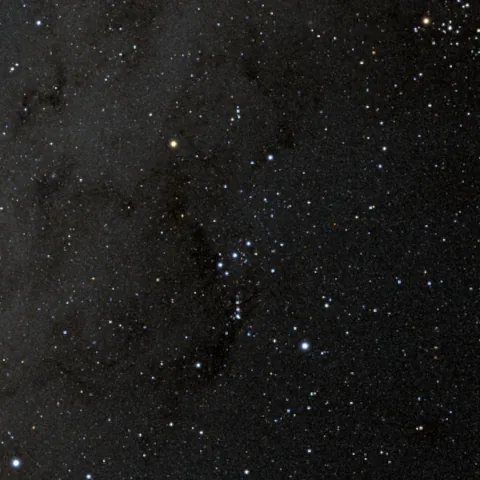
The fuzzy patch in Orion's sword is a star-forming cloud about 1,300 to 1,500 light-years away.
The Orion Nebula, M42 (opens in a new tab), is a cloud of gas and dust about 24 light-years across, a nursery of new stars. NASA's figures for its distance range from about 1,300 (opens in a new tab) to 1,500 light-years (opens in a new tab).
It sits among Orion's stars on the sky, but the belt stars above it lie at about 800 to 1,300 light-years (opens in a new tab): the nebula is in the same direction, at a distance of its own.
Sources for this section Kat Troche (Astronomical Society of the Pacific), A Flame in the Sky – the Orion Nebula, NASA Night Sky Network (2023) (opens in a new tab); NASA Science, Discovering the Universe Through the Constellation Orion (opens in a new tab); NASA Hubble, Messier 42 (the Orion Nebula) (opens in a new tab)
Beyond our Galaxy: the Andromeda Galaxy
The Andromeda Galaxy is ‘in’ Andromeda, yet millions of light-years beyond any of its stars.
Nearly every star you see at night belongs to the Milky Way. The Andromeda Galaxy (opens in a new tab), M31, is the exception: a separate galaxy of about a trillion stars, some 2.5 million light-years away, lying in the direction of the constellation Andromeda.
So the princess of the star map and the galaxy have nothing to do with each other except their place on the sky. NASA (opens in a new tab) calls M31 the nearest major galaxy to our own.
How to see it From a dark site in the Northern Hemisphere, find Andromeda on an autumn evening and look for a faint oval glow: the Night Sky Network (opens in a new tab) notes surprising detail is visible by eye from dark sites.
Sources for this section Kat Troche (Astronomical Society of the Pacific), Catch Andromeda Rising!, NASA Night Sky Network (2024) (opens in a new tab); NASA Hubble, Messier 31 (the Andromeda Galaxy) (opens in a new tab)
Sources
- Astronomy International Astronomical Union, The Constellations (opens in a new tab) for what 'in a constellation' means · checked 27 September 2026
- Astronomy NASA Space Place, What Are Constellations? (updated 2022) (opens in a new tab) for objects named after constellations · checked 27 September 2026
- Astronomy Kat Troche (Astronomical Society of the Pacific), A Flame in the Sky – the Orion Nebula, NASA Night Sky Network (2023) (opens in a new tab) for the Orion Nebula · checked 27 September 2026
- Astronomy NASA Science, Discovering the Universe Through the Constellation Orion (opens in a new tab) for distances in Orion · checked 27 September 2026
- Astronomy NASA Hubble, Messier 42 (the Orion Nebula) (opens in a new tab) for a second distance to the nebula · checked 27 September 2026
- Astronomy Kat Troche (Astronomical Society of the Pacific), Catch Andromeda Rising!, NASA Night Sky Network (2024) (opens in a new tab) for the Andromeda Galaxy · checked 27 September 2026
- Astronomy NASA Hubble, Messier 31 (the Andromeda Galaxy) (opens in a new tab) for M31 as our nearest major galaxy · checked 2 October 2026