Science & history · Constellation guide
Andromeda, the princess, and the galaxy beyond her
Andromeda is a chain of three bright stars running out from the Great Square of Pegasus. In its direction, far beyond its stars, lies the Andromeda Galaxy, M31, the most distant thing most people will ever see with their own eyes.
About this picture
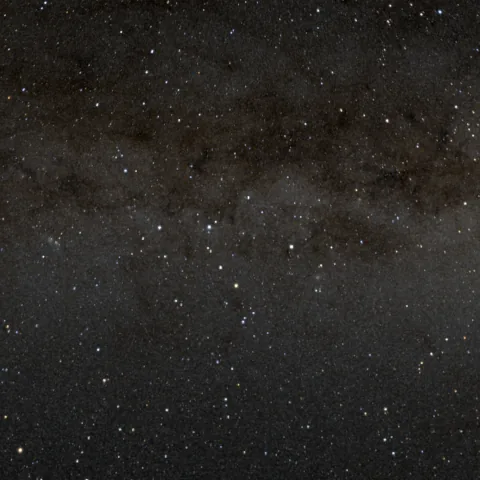
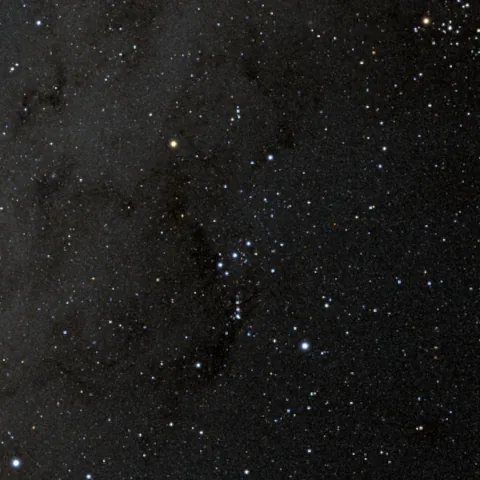
NASA/Goddard Space Flight Center Scientific Visualization Studio. Gaia DR2: ESA/Gaia/DPAC. Constellation figures based on those developed for the IAU by Alan MacRobert of Sky and Telescope magazine (Roger Sinnott and Rick Fienberg). NASA's page (opens in a new tab).
The map is a composite of 1.7 billion catalogued stars, not a photograph from one place: it shows stars far too faint for the eye, and no weather, Moon or city light. It is drawn here in this chart's projection, with each star where it was in 2000; the fastest-moving bright star has shifted about a minute of arc since, far less than a pixel here.
How to spot it: A line of three bright stars leading away from a corner of the Great Square of Pegasus. Source (opens in a new tab)
What you are looking at
A princess in chains, drawn with three bright stars, one of them borrowed from a horse.
Andromeda is the 19th largest (opens in a new tab) constellation, one of Ptolemy's 48. Her head is Alpheratz, alpha Andromedae, which Ptolemy listed under Pegasus as the horse's navel while acknowledging it was shared with Andromeda's head; the star now belongs to Andromeda alone, but its name, from the Arabic al-faras, “the horse”, keeps the double identity.
Her waist is Mirach (opens in a new tab), from the Arabic for “the girdle”, and her left foot is Almach, the IAU's spelling of a name the old Arab astronomers gave to the desert lynx, or caracal, they saw here. Through a small telescope Almach is a double star of contrasting yellow and blue.
The myth of the chained princess, her boastful mother Cassiopeia and the hero Perseus, which Ridpath retells (opens in a new tab) from Ovid, belongs to Historical beliefs.
Sources for this section Ian Ridpath, Star Tales: Andromeda (opens in a new tab)
The Andromeda Galaxy
In Andromeda's direction lies a whole other galaxy, 2.5 million light-years away.
M31, the Andromeda Galaxy (opens in a new tab), is the nearest major galaxy to our own, about 2.5 million light-years away. It is so large that it spans about six times the apparent width of the full Moon, though only its bright centre is easy to see.
The Night Sky Network (opens in a new tab) counts some trillion stars in it, appearing to the eye as a patch of haze of magnitude 3.4; NASA's Messier page gives 3.1. The light you see left those stars, the Network notes, when our earliest ancestors were working out stone tools.
Ridpath (opens in a new tab) calls it the farthest object visible to the naked eye. Its first recorded mention is in the tenth-century Book of the Fixed Stars by al-Ṣūfī, who called it “the nebulous smear”.
Sources for this section NASA Hubble, Messier 31 (the Andromeda Galaxy) (opens in a new tab); Kat Troche (Astronomical Society of the Pacific), Catch Andromeda Rising!, NASA Night Sky Network (2024) (opens in a new tab); Ian Ridpath, Star Tales: Andromeda (opens in a new tab)
How to find it
From the Northern Hemisphere, start from Cassiopeia or the Great Square of Pegasus on an autumn evening.
The Night Sky Network (opens in a new tab) notes that Andromeda becomes prominent as autumn arrives in the Northern Hemisphere, and recommends using the Great Square of Pegasus or Cassiopeia as guides to the galaxy.
By this site's calculation (opens in a new tab), Andromeda's middle stands about 85° up in the south at its highest from 40°N but only about 20° up in the north from 35°S, so it is best from the Northern Hemisphere; it is highest at about 9 p.m. local time in mid-November.
How to see it The galaxy lies on Andromeda's right hip, Ridpath notes (opens in a new tab), beyond Mirach and the two fainter stars above her girdle, mu and nu. Follow that short line away from Mirach and keep going about as far again for a small oval glow. Binoculars (opens in a new tab) make it much easier.
Sources for this section Kat Troche (Astronomical Society of the Pacific), Catch Andromeda Rising!, NASA Night Sky Network (2024) (opens in a new tab); Bright Star Catalogue, 5th Revised Ed. (Hoffleit & Warren 1991), as computed by this site's star engine (opens in a new tab); Ian Ridpath, Star Tales: Andromeda (opens in a new tab)
What you can actually see
A faint, elongated smudge by eye, a bright core in binoculars: not the spiral of the photographs.
By eye, M31 looks fuzzy (opens in a new tab), not like a star, and from a dark site surprising detail shows; even from moderately light-polluted places a persistent observer can catch its core if the sky is otherwise clear. Ridpath (opens in a new tab) describes it as an elongated blur on clear nights.
Binoculars (opens in a new tab) show the bright core and a little of its saucer-shaped disc. Telescopes show more, including two of its companion galaxies, M32 and M110, but often cannot fit the whole galaxy in view. Light pollution, thin cloud, smoke or haze all wipe out the fainter parts.
Keep in mind The famous spiral pictures are long exposures; NASA's Hubble mosaic (opens in a new tab) took over a decade to assemble. What your eye sees is real light from another galaxy, but it is a grey smudge.
Sources for this section Kat Troche (Astronomical Society of the Pacific), Catch Andromeda Rising!, NASA Night Sky Network (2024) (opens in a new tab); Ian Ridpath, Star Tales: Andromeda (opens in a new tab); NASA Hubble, Messier 31 (the Andromeda Galaxy) (opens in a new tab)
From nebula to galaxy
A century ago astronomers argued whether the Andromeda ‘nebula’ was part of the Milky Way at all.
As the Night Sky Network tells it (opens in a new tab), M31 was long called the Andromeda Nebula. In the “Great Debate” of 1920 Heber Curtis argued that it was a separate galaxy and Harlow Shapley disagreed. A few years later Edwin Hubble, building on Henrietta Leavitt's work with Cepheid variable stars, found Cepheids in it and showed it lay far outside our Galaxy.
Its spiral shape had first been caught on a photograph by Isaac Roberts in October 1887 (opens in a new tab); Ridpath notes that Roberts thought he was seeing a planetary system in the making.
Sources for this section Kat Troche (Astronomical Society of the Pacific), Catch Andromeda Rising!, NASA Night Sky Network (2024) (opens in a new tab); Ian Ridpath, Star Tales: Andromeda (opens in a new tab)
The galaxy is not the princess
The constellation's stars are in our Galaxy; the galaxy that shares its name is two million light-years beyond them.
Nearly every star you see at night belongs to our own Milky Way, and M31 is the exception (opens in a new tab): it only lies in the direction of the constellation. The constellation is an area of sky, and anything in that direction is “in Andromeda”, as the IAU (opens in a new tab) explains, without belonging to its pattern.
So the princess and the galaxy are unrelated except by line of sight: the galaxy is 2.5 million light-years away (opens in a new tab), far beyond the figure's stars. What is inside a constellation explains the idea with this and the Orion Nebula.
Sources for this section Kat Troche (Astronomical Society of the Pacific), Catch Andromeda Rising!, NASA Night Sky Network (2024) (opens in a new tab); International Astronomical Union, The Constellations (opens in a new tab); NASA Hubble, Messier 31 (the Andromeda Galaxy) (opens in a new tab)
Where on Earth, and when
The whole key pattern rises from anywhere north of about 48°S.
South of about 61°S, none of it rises.
North of about 61°N, the whole key pattern never sets.
Its middle climbs at least 20° high, the finder's threshold for a suggestion, from anywhere north of about 35°S.
It is highest in the evening sky, at about 9 p.m. local time, in mid-November, from either hemisphere, wherever it rises. With daylight saving time, that is nearer 10 p.m. on the clock.
Worked out by this site from the Bright Star Catalogue, for a flat, clear horizon. Hills, buildings, haze and city light all cut into this; the air also lifts objects near the horizon by about half a degree. For your own place and night, use the sky finder.
Sources
- History Ian Ridpath, Star Tales: Andromeda (opens in a new tab) for the figure, its star names, the galaxy's first record and photograph · checked 2 October 2026
- Astronomy NASA Hubble, Messier 31 (the Andromeda Galaxy) (opens in a new tab) for M31's distance, size and magnitude, and the Hubble mosaic · checked 2 October 2026
- Astronomy Kat Troche (Astronomical Society of the Pacific), Catch Andromeda Rising!, NASA Night Sky Network (2024) (opens in a new tab) for finding M31, what eye, binoculars and telescopes show, and its history · checked 27 September 2026
- Astronomy International Astronomical Union, The Constellations (opens in a new tab) for what 'in a constellation' means · checked 27 September 2026
- Astronomy Bright Star Catalogue, 5th Revised Ed. (Hoffleit & Warren 1991), as computed by this site's star engine (opens in a new tab) for its height from 40°N and 35°S, and best month